
When everyone becomes a Curator
On the rise of taste and the shrinking hunt for interior bargains in Germany.

Ebay Marketplace in Germany used to feel like a digital flea market — unpredictable, a little chaotic, full of chance discoveries. Lately, I’ve been observing private sellers turning into curators, transforming their listings into small interior boutiques. Here’s my take on what that means for the thrill of the hunt, the rise of taste, and how to still find something truly unique.
I still open eBay Kleinanzeigen (eBay Marketplace) the way some people check the news — almost automatically, with a small pulse of curiosity. What once started as a harmless habit after moving into my first apartment became a fullblown addiction.
— typing a few search words into eBay Kleinanzeigen (eBay Marketplace), seeing what might appear: a 70s glass table, a forgotten Thonet chair, maybe a set of chrome candleholders that look better in the photo than they probably do in real life.
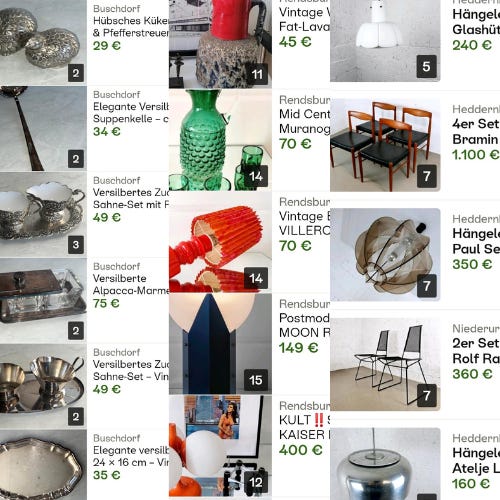
What once resembled a digital flea market — messy, unpredictable, a little chaotic — has slowly turned into a curated exhibition of private taste.
Scrolling through listings now feels like walking through a hundred small interior boutqiues at once, each one telling a story about how we live, what we value, and how we want to be seen.
The New Curators
You can spot them immediately. Their photos might look familiar to you, still real but intentional — a danish lamp set against white walls, a plant and picture gallery in the background, or maybe some Bruno Rey chairs on a minimal concrete floor.
They don’t just sell; they stage.
The captions read more like exhibition labels than sales posts: “Mid-century side table, good vintage condition, light patina consistent with age.”
These are not professional dealers; they’re private individuals who have turned their personal taste into a form of authorship. Each account feels like a microcosm of aesthetic identity — chrome minimalists, brutalist collectors, lovers of rattan and warm teak wood.


It’s a fascinating shift.
What used to be a space for casual resale has evolved into something closer to self-expression through curation.
Every listing is a moodboard; every seller, a small brand of one.
And honestly, I love and hate it at the same time!
There’s something deeply human about it — this instinct to arrange, to edit, to give meaning to objects. It’s the same impulse that drives interior design itself: the urge to make sense of who we are through what we surround ourselves with.
Curation, here, is not just about beauty — it’s about knowledge as value.
And that’s where my ambivalence begins.
Why I Love and Hate It
I love it because I can now follow people whose taste I admire.
Following these sellers has turned my Marketplace feed into a small moodboard of German interiors — each profile representing a niche of taste ( think Bauhaus, mid-century modern and brutalism). There’s someone who only sells chrome and smoked glass; someone obsessed with mid-century teak furniture or Italian lighting; and another who flips IKEA pieces with a collector’s eye for proportion.
My feed has turned into a visual education in contemporary taste.
But I also hate it — because the more curated it becomes, the less room there is for surprise.
The listings are cleaner, the prices higher, the imperfections edited out.
The sense of serendipity — that small joy of stumbling upon a rare piece under bad lighting — is slowly vanishing.
I’ve heard that long time thrifters feel that the fun is fading — that the hunt has turned too strategic, too branded.
And there’s truth in that. When every private seller becomes a curator, the spontaneity that defined second-hand culture starts to thin out.
Has private taste become public commerce?
Every seller is both archivist and entrepreneur, offering their aesthetic to the highest bidder — or at least to the one who arrives first for pick-up.
The days of stumbling upon a Ingo Maurer floor lamp for €30 are mostly gone.
Most private sellers now know exactly what they’re sitting on. A quick Google or Etsy search tells them the market value, and suddenly that “bargain” becomes a “design piece, rare, €280 VB.”
It’s not greed, really — it’s knowledge. The line between collector, reseller, and hobbyist has blurred.
And while it’s wonderful to see vintage design appreciated for its craft, it also means that eBay Marketplace no longer rewards randomness the way it used to.
Maybe this is just how culture works: once we recognize the value of something, we organize it.
We name it, frame it, price it — and in doing so, we tame it a little.
It’s beautiful, but it also makes me miss the mess.
Still, I can’t help but admire this shift. It reflects something bigger happening in Germany’s second-hand culture. The power once held by boutiques and professional dealers now also belongs to ordinary people sharing their own sense of taste.
Curation as a social language
What fascinates me most is how curation itself has become a kind of social language.
People no longer just sell an item — they communicate through it.
Maybe I’m reading too much into it, but when I look at listings now, I can’t help but see them as small acts of communication.
Even though someone is letting a piece go — or simply trying to make some space or profit — the way they present it still tells a story about what they value. The lighting, the background, the caption — all of it gives away a little about their taste, their priorities, their idea of beauty.
I often find myself curious about what else they’re selling. One listing leads to another, and before I know it, I’m following them — not just to catch the next item, but because their eye speaks to me. It’s as if each seller builds a small world through their objects, and by following them, I get to wander through it.
It’s both intimate and performative. It democratizes design while simultaneously making it more competitive. It invites everyone in and expands the understanding of what “good taste” looks like.
How to Still Find the Good Stuff
The thrill of finding a piece that feels yours isn’t gone, don’t be discouraged — the magic is still there. It just asks for a little more observation. Here are my field notes for the modern hunters out there.
1. Follow your taste, not the trend.
Decide what really attracts you — materials, colors, shapes. Maybe it’s chrome and glass; maybe it’s burl wood or woven rattan. Once you know that, the algorithm starts to learn with you.
2. Save searches, follow sellers and be patient.
3. Make it local, make it human.
Whenever possible, pick up items in person. You’ll often learn who owned it, where it was produced — and that, to me, not only makes the object more special but also adds that human factor and exchange I’m missing from online shopping.
4. Look beyond “design names.”
In Germany, many great pieces are by unknown makers or regional manufacturers. They may never appear in a design catalog, but they can still carry the same charm and quality.
5. Be ready to move fast, but stay kind.
Good deals vanish within minutes. Having your polite inquiry template ready (“Hallo, ist der Artikel noch verfügbar? Wären Sie auch einverstanden mit X€”) is half the game.
6. Don’t chase perfection.
If you are searching for second hand - chances are that a piece has a scretch, dent or a stain. Don’t let that deter you - oftentimes it can be dealt with through proper care (wood treatments are easily accessible and professional cleaning is affordable)
The Broader Interior Second-Hand Landscape
Germany’s second-hand culture has grown far beyond eBay Kleinanzeigen (Marketplace).
There’s Vinted (formerly Kleiderkreisel) for clothes and now more and more interior items too, Etsy for smaller resellers and countless Instagram accounts where individuals build micro-businesses around their aesthetic niche.
More commercial second-hand market places have also been emerging over the past years like Pamono, catawiki, cocoli or Whoopah.
Together, they form a patchwork of how design now circulates in our culture: not from factories to homes, but from person to person.
If you’d like, I can do a closer look into each of these marketplaces — how they differ, how to recognize value, and where the real deals still hide.
Just let me know in the comments if you’d enjoy that deep dive next.
We ran a curated vintage shop from 2021–2023, and it’s fascinating to see how common reselling vintage has become as a business since then. On the one hand, it’s nice — more pieces get a second life. On the other hand, it has become much harder to catch real bargains. The trendy pieces are gone within minutes. Finding your own taste is the logical consequence of that, just as you said so well.